We are pleased to share a new publication by Qisheng and Youngah, titled ToneCL: Contrastive Learning for Few-Shot Syllable-Level Tone Classification, published in the Proceedings of the 15th International Joint Conference on Natural Language Processing and the 5th Conference of the Asia-Pacific Chapter of the Association for Computational Linguistics (Volume 1: Long Papers).
In this study, Qisheng and Youngah introduce ToneCL, a lightweight contrastive learning framework designed for few-shot syllable-level tone classification. Contrastive learning allows a model to learn useful speech representations from large amounts of unlabeled audio before being fine-tuned with only a small number of labeled examples. This approach is particularly valuable for low-resource languages, where annotated speech data are often scarce and expensive to collect.
To evaluate the framework, the authors simulated low-resource conditions using Mandarin and Vietnamese speech data, limiting training data to only tens of labeled examples per tone category. ToneCL consistently outperformed comparison methods, achieving 91.6% accuracy on a six-speaker Mandarin dataset with just ten labeled examples per tone. The study also demonstrated strong cross-lingual transfer, showing that pretraining on Vietnamese speech can effectively support tone classification in Mandarin. An ablation analysis further revealed that frequency band rejection was the most important augmentation technique contributing to the model’s performance.

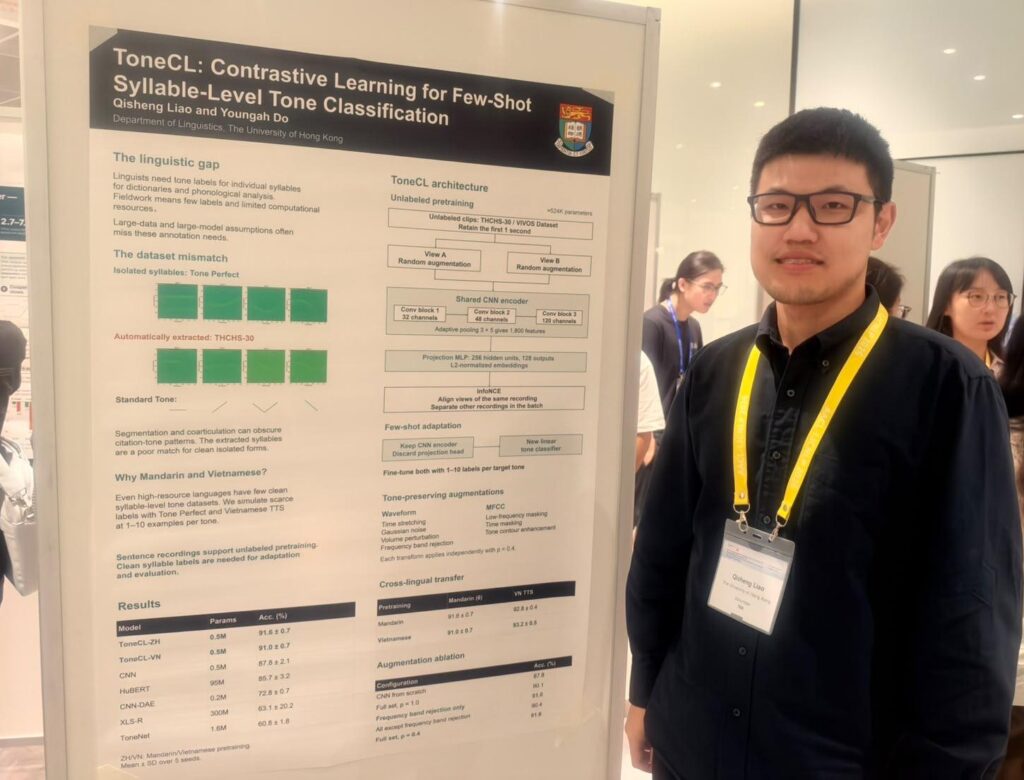
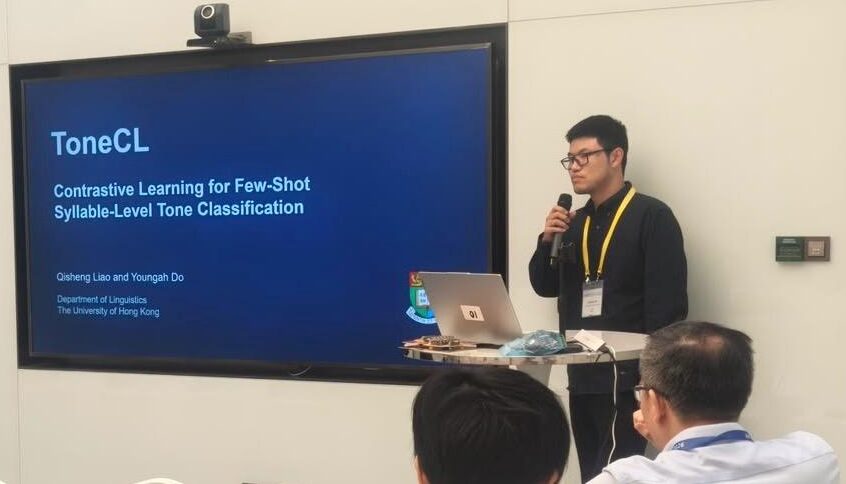
In addition to the publication, Qisheng presented “ToneCL: Contrastive Learning for Few-Shot Syllable-Level Tone Classification” as an oral presentation at the AACL-IJCNLP 2026 main conference. The talk was part of the Machine Translation and Phonology session, held on Saturday, November 7. The presentation provided an opportunity to share the study’s findings with the wider computational linguistics community as part of a conference program.
Liao, Q., & Do, Y. (2006). ToneCL: Contrastive learning for few-shot syllable-level tone classification. In Y. Zhang, R. Xu, A. Purwarianti, T. Rong, & J. Suzuki (Eds.), Proceedings of the 15th International Joint Conference on Natural Language Processing and the 5th Conference of the Asia-Pacific Chapter of the Association for Computational Linguistics (Volume 1: Long Papers) (pp. 1513–1525). Association for Computational Linguistics. open_in_new URL